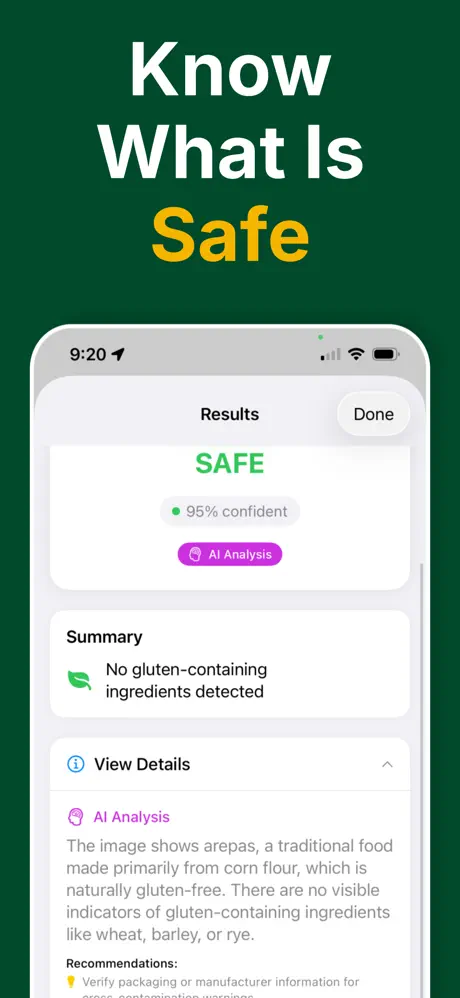
GF Scanner turns long ingredient panels into a clear gluten-free answer, flagging hidden wheat terms, malt, modified starches, and risky flavorings in seconds.
Scan to download
Scan food labels and barcodes to detect gluten instantly. AI-powered ingredient analysis in 33 languages for people with celiac disease and gluten sensitivity.
Open the app and point your camera at any food label. The scanner reads the ingredient list instantly — no typing needed.
See a clear safe or unsafe verdict with detailed explanations. Hidden gluten sources like maltodextrin or modified food starch are flagged automatically.
Save results to your history, scan barcodes for quick lookups, and share findings with family or caregivers.
Common hidden sources include malt (malt vinegar, malt extract, malt flavoring), brewer's yeast, seitan, hydrolyzed wheat protein, and some soy sauces. Any ingredient listing wheat, barley, rye, or triticale — or their derivatives — should be treated as unsafe unless the product is labeled gluten-free.
No. Wheat-free products can still contain barley (including malt) or rye, both of which contain gluten. Always look for an explicit "gluten-free" claim certified to under 20 ppm.
Maltodextrin sold in the US is almost always gluten-free — it is typically made from corn, rice, or potato, and even wheat-derived maltodextrin is processed below detection limits. Outside the US, confirm with a gluten-free label to be safe.
Usually yes. In the US, any wheat used in natural flavors must be disclosed on the label under FALCPA. Barley and rye are not required disclosures, so celiacs should still verify with a gluten-free claim when in doubt.
Oats are naturally gluten-free but are frequently cross-contaminated with wheat during growing and milling. Only buy oats labeled "certified gluten-free" — standard oats are not safe for celiacs.
Download GF Scanner and turn long ingredient panels into faster gluten-free answers on iPhone.
Download Free
Scan to download