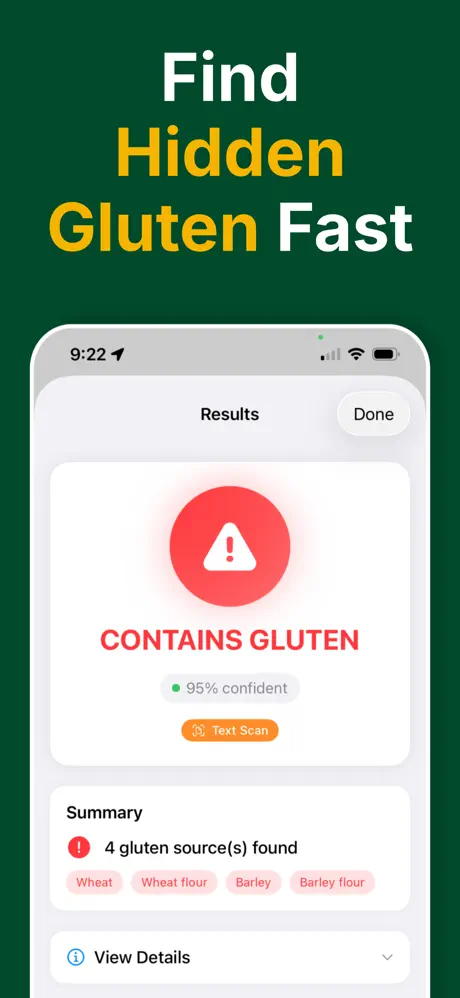
GF Scanner turns long ingredient panels into a clear gluten-free answer, flagging hidden wheat terms, malt, modified starches, and risky flavorings in seconds.
Scan to download
Scan food labels and barcodes to detect gluten instantly. AI-powered ingredient analysis in 33 languages for people with celiac disease and gluten sensitivity.
Open the app and point your camera at any food label. The scanner reads the ingredient list instantly — no typing needed.
See a clear safe or unsafe verdict with detailed explanations. Hidden gluten sources like maltodextrin or modified food starch are flagged automatically.
Save results to your history, scan barcodes for quick lookups, and share findings with family or caregivers.
Even trace gluten can trigger intestinal inflammation, often causing bloating, diarrhea, fatigue, or brain fog within hours to days. Repeated exposure — even without visible symptoms — damages the small intestine and raises long-term health risks.
Research suggests less than 10 mg of gluten per day is tolerated by most celiacs — roughly 1/100th of a slice of bread. This is the basis for the FDA's 20 ppm threshold for "gluten-free" labeling.
Celiac disease is an autoimmune condition where gluten triggers damage to the small intestine and is diagnosed via blood test and biopsy. Non-celiac gluten sensitivity causes similar symptoms without the intestinal damage or autoimmune response.
Yes. Shared toasters, fryers, cutting boards, and utensils can transfer enough gluten to trigger a celiac reaction. Restaurants without dedicated gluten-free prep areas are high-risk even when dishes are nominally gluten-free.
No. Celiac is a lifelong autoimmune condition. Symptoms improve on a strict gluten-free diet, but reintroducing gluten will retrigger the immune response, even after years of remission.
Download GF Scanner and turn long ingredient panels into faster gluten-free answers on iPhone.
Download Free
Scan to download